
TETRA PAK SUSTAINABILITY
Our commitment towards sustainable food systems
At Tetra Pak, our sustainability agenda is shaped by our purpose ‘We commit to making food safe and available, everywhere, and we promise to protect what’s good: food, people and the planet.’
Our approach to sustainability
We provide advanced food systems – from product creation and recipe testing to processing, filling, packaging, logistics, services and beyond. In today’s world, where we face the immense, interconnected challenges of feeding a growing population while protecting our natural resources and combating climate change, our Strategy 2030, guided by our purpose, is essential in shaping the company we want to be in the future. We are committed to leading the sustainability transformation of our industry through low-carbon circular-economy solutions and by enhancing sustainability across the supply chain.
In the same way that sustainability must drive value to people and planet, we also take our responsibility to customers and the agri-supply chain seriously by embedding sustainability into the core of the business to create value for all.
Committed to openness and transparency
We are committed to monitoring, managing and transparently reporting on our performance and progress.
Our sustainability agenda is based on our double materiality assessment, which was refined in 2025 and is aligned with the requirements of the European Sustainability Reporting Standards (ESRS). The assessment considers our impacts on people and the environment, as well as the material risks and opportunities that various environmental, social and governance topics have on our business.
The Tetra Pak Sustainability Agenda
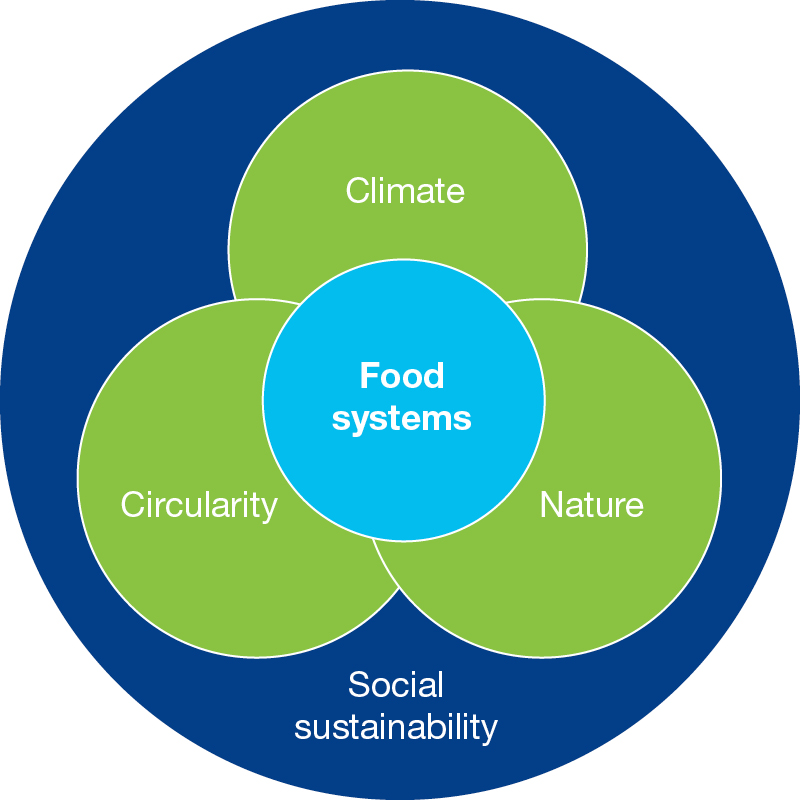
Sustainability highlights
Get the full story on our sustainability work at www.tetrapak.com/sustainability.
Tetra Pak helps customers make their factories AI-ready
Tetra Pak’s next-generation Automation and Digitalisation portfolio, Tetra Pak® Factory OS™, delivers contextualised, real-time insights for smarter, faster decision-making in food and beverage production. Tetra Pak® Factory OS™ connects processes, data and user experience in one scalable, configurable platform – turning fragmented data into actionable insights that drive real results. This new suite of modular, open and scalable smart factory technologies will transform food and beverage production and lay the foundation for AI-ready factories.
Innovative homogenizer reduces energy consumption and costs
With traditional homogenization often requiring two separate devices, Tetra Pak has created a homogenizer that combines both devices into a single homogenization unit. The Tetra Pak(R) Homogenizers 15C and 20C can reduce energy consumption by up to 25%* thanks to the innovative HD21 device. The new solution offers manufacturers a streamlined and efficient solution with a lower initial investment. In addition, the unit makes long-term maintenance savings as it is designed to minimise the wear of parts to make them last longer.
With a compact design, simplified installation and plug-and-play set up, the Tetra Pak(R) Homogenizers 15C and 20C are easy to integrate and operate in existing lines.
* Based on the following production scenario: “Pasteurized milk, NIZO 66%, 14 days of shelf life, 2000 L/h and compared to alternative homogenization devices in the market.”
New heat pump system revolutionises pasteurization efficiency
Tetra Pak’s new Integrated Heat Pump system is designed to electrify pasteurization and reduce energy consumption by up to 77%. The system reduces the use of fossil fuels in the conventional boiler, and the electricity use in the chiller system by combining heating and cooling into one efficient electric solution. It recovers waste heat from pasteurization – converting 1 kWh of electricity into up to 2 kWh of usable heat – making it around three times more efficient than conventional systems. The system can enable large-scale dairy or juice operations to save around €230,000 per year in operating costs and cut CO₂ emissions by up to 650 tonnes annually.**
** Example savings scenario for a typical dairy line in France, producing 60,000 litres of milk/hour, operating 6,000 hours/year. Actual savings will vary based on specific conditions in your market, including electricity costs, fossil fuel costs and taxes or fees related to greenhouse gas emissions.
24FY Sustainability Report Highlights***
- 178 billion food and beverage packages delivered worldwide
- 94% renewable electricity consumption in Tetra Pak operations (on track to meet our 2030 target)
- 87% employee engagement score
- €42 million invested to support collection, sorting and recycling of our packages globally
- €100 million invested in research and development addressing packages sustainability
- -25% in total value chain GHG emissions (scope 1, 2 and 3) since 2019 (-7% reduction since 2023)
- -54% in own operations GHG emissions (scope 1, 2 and business travel) since 2019
*** Published June 2025.
External recognition
Acknowledgement from international organisations helps us to benchmark our sustainability efforts. 2025 highlights included:
EcoVadis
We received a platinum medal in 2025, putting us in the top 1% of all companies assessed.
CDP
We were recognised by CDP, the global environmental disclosure system, for our continued transparency and action on environmental issues. Tetra Pak achieved an A- score for Forests, marking ten consecutive years in CDP’s leadership band (A or A-), and an A- score for Water Security for the third year running.
SEAL Business Sustainability Awards
Our comprehensive Approach to Nature Framework won the Environmental Initiatives Award and was recognised as an industry-leading strategy for addressing biodiversity loss and water security across the entire value chain.
Financial Times Best Employers 2025
We were named one of Europe’s Best Employers 2025 by the Financial Times, ranking in the top ten for our sector, in recognition of our ability to provide a workplace experience that empowers employees to make an impact.