
DELAVAL
SUSTAINABILITY

We make sustainable food production possible
We have refined our approach to sustainability to ensure it covers everything we do – both within our company and how we benefit our customers. Based on direct customer insight and our materiality analysis, we developed a new sustainability model in 2019. The model focuses on three main perspectives – Environment, Food and Animal Welfare, and Social and Economic.
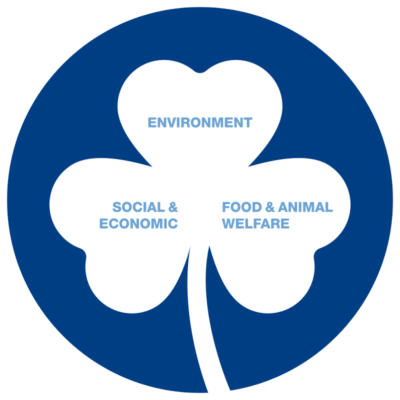
Environment
The greatest environmental contribution we can make is on the farms of our customers as we strive to reduce the environmental impact of every litre of milk produced. This typically involves providing solutions that improve efficiency and milk yield.
Within our own operations, we are committed to constantly finding ways to reduce waste, and the use of energy and water.
We are also committed to contributing towards a low carbon economy by taking action to combat climate change and its impacts.
Food and animal welfare
Contaminated milk presents obvious risks to both consumer health and the operations of our customers. Food safety is critical for all parts of the dairy value chain. We work with food safety through stringent compliance controls but also by promoting animal welfare.
A healthy animal provides more milk, at a better quality and for more years. By providing better conditions for animals, farmers can improve the animal’s health and longevity while at the same time maintaining or improving farm profitability and reducing their environmental impact.
Social and economic
Social sustainability involves respecting and advancing human rights as they are defined by the UN. Economic sustainability is how we create long-term economic growth without negatively impacting social or environmental sustainability.
Our Corporate Governance framework including our Code of Business Conduct guides us in how to act sustainably, and in compliance with laws and ethical standards. Through innovation, we provide solutions to dairy farmers to make their lives easier and their farms more profitable whilst reducing their environmental impact.
Key sustainability challenges for DeLaval
During 2019, we identified 12 key sustainability challenges that we will focus on. Each challenge is driven by a member of our Group Management and during 2020 we will work on setting targets for our challenges.
Environment
Waste and recycling
Sustainable waste management and
recycling policies.
Emissions to air
Reduction of carbon emissions throughout the whole value chain.
Natural resources
Usage of materials in a way that does not lead to the depletion of natural
resources.
Water use
Responsible water use in both products and processes.
Food and Animal Welfare
Food safety
Meet all regulations regarding food safety to ensure milk is safe to consume.
Animal welfare
Extend longevity and improve milk yield by creating the best possible living standards for cows on farms.
Product development
Develop products that increase productivity to help farmers do more with less.
Partnerships
Ethical business partnerships that can help us achieve our corporate goals.
Social and Economic
Diversity and inclusion
An inclusive work environment with equal opportunities for all.
Employee satisfaction & wellbeing
A safe and healthy work environment with an ambition to have zero accident and no work-related illness.
Work efficiency
Develop products and processes that result in more efficient use of resources, while ensuring data security.
Profitability
Make sure both our own operations and our customers’ businesses are profitable in the long-term.
At DeLaval we aim to contribute toward the UN Sustainable Development Goals. The most relevant goals to our business are:



The United Nations has set 17 sustainable development goals as a blueprint to achieve a more sustainable future for all. These goals address the global challenges we face today covering areas such as poverty, inequality and climate change. At DeLaval, we have looked at how we can contribute to these goals based on the challenges facing our customers and our industry.
Within our three sustainability categories, we have identified the following UN Sustainable Development Goals and the specific targets that the UN has set for each goal where we believe we can contribute the most.