

Protects what’s good
Tetra Pak is the world leader in food processing and packaging solutions. For 70 years, we have worked with customers around the globe to help make food safe and available, everywhere.
We continuously innovate to deliver on our promise – PROTECTS WHAT’S GOOD™ – to our customers, consumers, partners and people all over the world. To us, our promise is a commitment to protect food, people and the planet.
Our approach
Our commitment means protecting food, through our processing, packaging and service activities. It means protecting people both inside and outside our organisation, as well as protecting the future of our planet, our customers and our company.
We work together with our customers to provide food and beverage processing and packaging solutions that reach all corners of the world. We’re passionate about delivering food of the highest quality and safety to people, wherever and whenever it’s needed.
Long history of working with sustainability
Tetra Pak was founded by Dr. Ruben Rausing on the idea that a package should save more than it costs. Armed with this mindset today, our ambition is that our commitments, solutions and partnerships help protect our planet by leaving a positive impact on our climate and resources.
We are committed to reduce the environmental footprint of our products and services, and consistently pursue and initiate collective actions that will help create a sustainable tomorrow without compromising food safety or quality.
Products & solutions
Our customers come from across the food industry, providing consumers with a broad range of dairy products and dairy alternatives, beverages, prepared foods, cheeses, ice creams, wines, spirits and powdered products.
Tetra Pak is uniquely equipped to provide solutions that meet our customers’ entire needs. We provide solutions for processing, packaging and distributing a wide range of food products. We are experts in minimising raw material and energy consumption during manufacturing and distribution – to maximise operational and environmental performance.
Our portfolio is broad, and includes:
• Carton packages
• Processing equipment
• Packaging equipment
• Distribution equipment
• Automation solutions
• Services
Net sales 2021
€11.1
BILLION
sales in
>160
COUNTRIES
number of employees December 2021
25,147
CUSTOMER INNOVATION CENTRES
6
TECHNICAL TRAINING CENTRES
8
Research and Development Centres
6
production PLANTS
547)
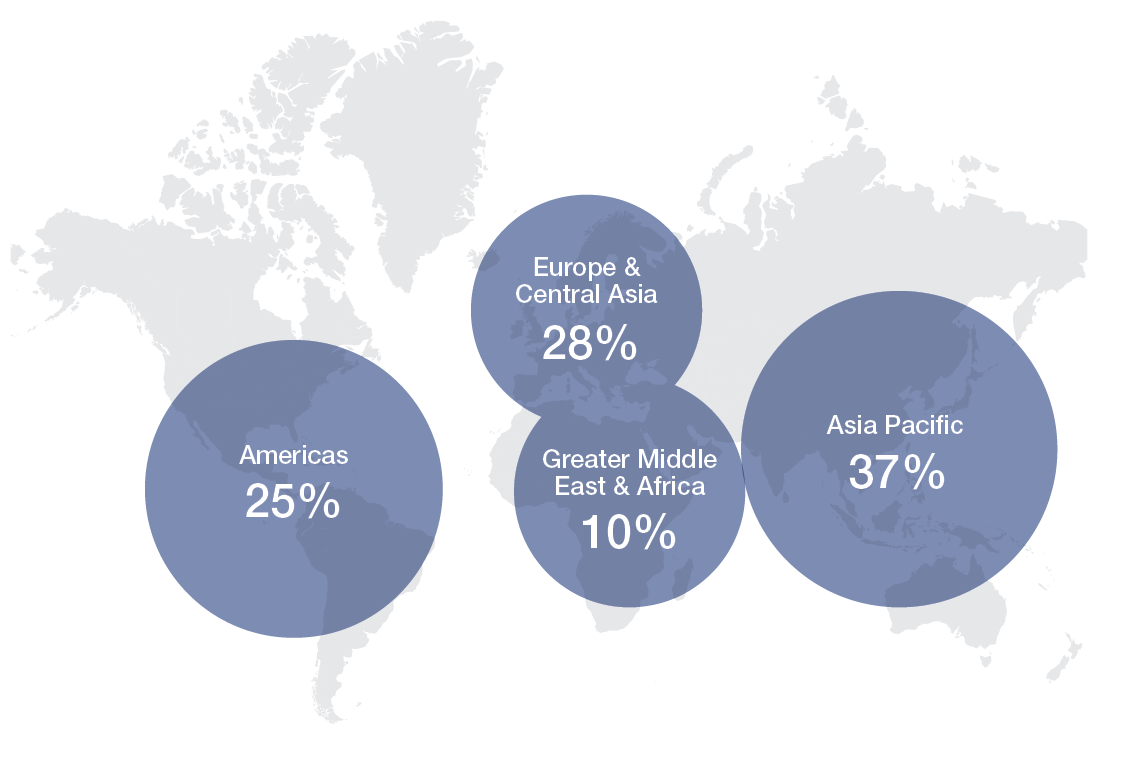
TETRA PAK NET SALES by geography, 2021
TETRA PAK PACKAGING MATERIAL NET SALES PER category, 2021

Liquid Dairy Products
58.1%

Juice & Nectar
14.0%

Still Drinks
9.6%

Food
6.4%

Plant-based products
8.8%

Wine & Spirits
2.0%
Others: 1.1%
Market
In 2021, the speed of change accelerated with sustainability, health, convenience and premiumisation increasing in importance in Tetra Pak’s food and beverage categories:

Dairy products
White milk continues to account for the largest proportion of total consumption as it has remained a nutritious food staple during the pandemic. Milk continued to grow in 2021 and is expected to grow by 1.9 per cent around the world until 2024, except in Europe and North America, which are expected to see declines.
Consumers spending more time at home during the COVID-19 pandemic increased cheese sales by 36 per cent. Cheese is also perceived as being healthy and nutritious, as well as a useful snack and ingredient.
Baby and Toddlers Dairy drinks increased with a Compound Annual Growth Rate (CAGR) of 4.6 per cent with parents concerned for their kids’ health. The food supplements nutrition category reached 10.6 billion litres in 2021 with a 11.2 per cent growth.

Juice, nectars and fruit flavoured still drinks
Despite the decline in previous years, juice and nectar consumption was flat in 2021 with a 0.6 per cent increase compared with 2020. The category benefitted from people spending more time away from home and innovative new product launches that drew on sustainability and functional juice drinks.

Ice cream
Ice cream is growing as innovation keeps producers ahead of commoditisation. Consumers are looking for indulgence and convenience, while balancing health and ethical solutions.

Plant-based products
Ready to drink plant-based beverage consumption globally reached 12.7 billion litres in 2021 with an annual growth of +2.0 per cent (18-21 CAGR). Global growth is driven by the Rice Nuts Grains Seeds segment, which accounts for 59 per cent of total consumption. Consumption also is accelerated by a growing interest in flexitarian diets and plant-based proteins, as well as ethical and sustainability concerns. Plant-based beverages are forecast to grow at a CAGR of +8.5 per cent until 2024.

Food
Growth in packaged food categories has been driven by the pandemic as more people have cooked at home. The concept of packaged food as ‘kitchen-helpers’ is growing.

Powder
Demand for dairy based powders continues to grow. There are significant market opportunities in the category driven by greater nutritional awareness in developing countries and the protein trend. Infant formula remains the highest growth area.

OTHER BEVERAGES
Packed water continued its positive trend in 2021, with an annual growth of 4.4 per cent. The water category is driven by sustainability and functional claims, as well as other beverages such as ready-to-drink tea and coffee, sport and energy drinks.
Technology
Tackling tethered cap challenges head on
Tetra Pak is working to develop tethered caps to ensure its customers comply with the EU Single Use Plastics (SUP) Directive by 2024. However, tethered cap solutions, which will help reduce litter as the cap stays attached to the package, are a challenge due to the scale of change they require throughout our value chain while minimising impact on customers operations.
We are proactively working to limit disruption on more than 1,000 packaging lines by maintaining cap dimensions, and weights and interfaces, while delivering new functionality at the usual standard of performance and quality. At the same time, we are moving towards more recyclable and renewable materials for our caps, which adds a further layer of complexity to the development process.
Ultrasonic sealing allows aseptic sustainable packaging
In new sustainable packaging material, the aluminium barrier is replaced with either a polymer or fibre barrier, which facilitates recycling and reduces the carbon footprint of our Tetra Brik® Aseptic packages. However, an alternative to Induction Sealing was required to seal the more sustainable packaging material.
Tetra Pak has successfully adapted Ultrasonic Sealing technology, which can be used to seal both non-foil and foil packaging, to the aseptic environment. To speed up the learning curve and boost the introduction and deployment of the technology, Tetra Pak has partnered a large ultrasonic company and are transferring expertise to key people.